
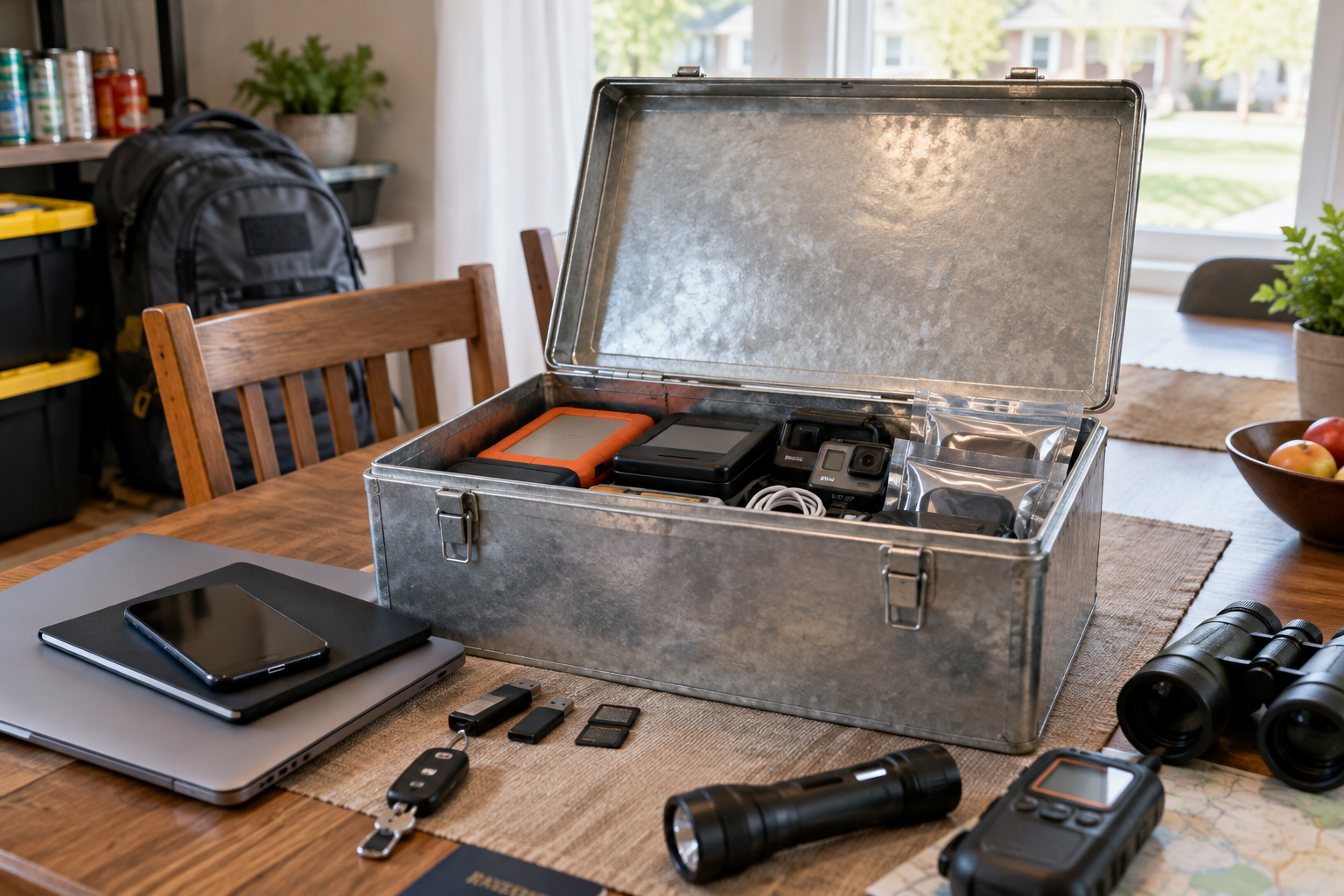
Knowing what to put in a faraday cage allows suburban families to shield essential electronics from catastrophic electromagnetic pulse events and coronal mass ejections. Priorities include off-grid communication radios, solar power components, digital medical monitors, backup storage drives with critical documents, and rechargeable flashlights wrapped in non-conductive insulating layers inside conductive metal containers.
Why Suburban Families Need EMP Shielding Protocols
Electromagnetic pulses (EMPs) and extreme geomagnetic storms threaten modern electrical grids by inducing massive voltage surges in unshielded circuitry. For households focused on suburban family preparedness, reliance on microchip-driven equipment creates significant vulnerability during prolonged utility failures. Solid-state microprocessors in consumer electronics can experience junction burnout when exposed to rapid electromagnetic radiation fields.
Creating insulated metallic enclosures creates a protective barrier known as a Faraday shield. By surrounding sensitive equipment with continuous conductive material, incoming electromagnetic waves redistribute along the exterior outer shell without penetrating the interior chamber. Storing spare components in protective containers ensures critical devices remain functional when primary grid infrastructure goes offline.
What to Put in a Faraday Cage for Emergency Preparedness
Deciding what to put in a faraday cage requires prioritizing high-value gear that cannot easily be replaced or bypassed during an extended grid failure. Rather than attempting to shield every electronic household item, families should focus on tools that maintain communication, power generation, medical safety, and access to essential records.
Critical Off-Grid Communication Devices
Maintaining communication during widespread infrastructure outages is vital for household security and coordination. Small handheld two-way radios, Family Radio Service (FRS) handsets, and General Mobile Radio Service (GMRS) units should be stored inside protective enclosures with their batteries removed. Portable emergency weather radios capable of receiving public safety broadcasts should also be included.
Ham radio operators should store spare handheld transceivers, portable high-frequency (HF) rigs, and spare digital interface modems. Antenna coax leads and external power cables must be disconnected before storage, as attached wires act as lightning rods for electromagnetic energy. Storing a secondary communication kit ensures your family can monitor regional emergency channels when commercial networks fail.
Solar Power Components and Charging Gear
Modern off-grid power solutions rely on delicate electronic microcontrollers that remain vulnerable to high-voltage spikes. While rigid solar panels often survive pulse events due to their simple construction, maximum power point tracking (MPPT) charge controllers, solar generators, power inverters, and battery management circuitry contain delicate microchips susceptible to surge damage.
Store spare charge controllers, power cables, portable power bank batteries, and small step-down voltage regulators inside conductive shielding. When deciding what to put in a faraday cage, prioritize items that convert solar energy into usable battery storage so your household maintains continuous access to light and radio power.
Essential Family Medical Electronics
Families with specific healthcare monitoring requirements must protect electronic medical equipment from pulse threats. Digital blood pressure monitors, pulse oximeters, blood glucose meters, and portable nebulizers contain sensitive microcircuits that require shielding. Spare charging units for hearing aids and specialized medical power supplies should also be sealed inside protective containers.
Store manual backup medical tools such as mechanical blood pressure cuffs and analog thermometers alongside shielded electronic devices. Combining shielded digital equipment with traditional non-electric backups ensures household health monitoring remains uninterrupted during emergency scenarios.
Information Backup Devices and Flash Drives
Digital records contain vital family information, including identity documents, insurance policies, property deeds, medical histories, and personal photograph archives. Unshielded solid-state drives (SSDs), USB flash drives, memory cards, and hard drives can suffer data corruption when subjected to intense electromagnetic fields.
Store encrypted backup drives inside small shielded containers or specialized signal-blocking pouches. Keep an older offline laptop or tablet loaded with reference materials, home repair manuals, survival guides, and medical encyclopedias inside the same enclosure to ensure you can read stored digital files when external internet access is unavailable.
What to Put in a Faraday Cage for Daily Utility and Backup Power
Evaluating what to put in a faraday cage for long-term survival involves balancing space constraints with practical emergency utility. Storing duplicates of everyday items provides redundant capabilities if primary household electronics fail during severe power outage scenarios.
Emergency Lighting and Power Accessories
Rechargeable LED flashlights, headlamps, and battery-powered lanterns contain small control boards regulating brightness and battery output. Keep duplicate rechargeable headlamps, spare lithium-ion batteries, smart battery chargers, and power outage preparedness gear inside your Faraday enclosure.
Include multi-meters and electronic circuit testers inside your enclosure. Diagnostic tools allow you to check battery voltage and troubleshoot electrical connections safely when repairing off-grid power systems after a severe storm event.
Can a Faraday Cage Stop an EMP from Damaging Electronics?
A properly designed Faraday shield can effectively block damaging electromagnetic energy from reaching sensitive interior electronics. According to Cybersecurity and Infrastructure Security Agency guidelines, continuous conductive shielding attenuates radio frequency radiation by providing a low-resistance path around stored contents. High attenuation ratings, measured in decibels (dB), reduce the magnitude of voltage surges induced across internal circuits.
To successfully stop pulse energy, an enclosure must possess no continuous gaps, unshielded seams, or direct metal contact with stored items. Electromagnetic energy can penetrate minor openings if the wavelength of the radiation is smaller than the gap in the shield. Utilizing nested layers of conductive shielding, such as placing a sealed metal container inside another insulated metal bin, dramatically increases overall protection against intense frequency spikes.
How to Construct and Test a DIY Home Faraday Box
Building effective household shielding does not require expensive industrial hardware. Galvanized steel trash cans, heavy-duty aluminum ammo cans, and thick foil-lined storage boxes can provide reliable protection when assembled correctly. Guidance aligned with FEMA emergency preparedness recommendations emphasizes simple structural integrity and proper insulation layers.
Nesting Shields and Non-Conductive Insulation
The core principle of DIY shielding requires absolute electrical isolation between stored electronics and the outer conductive metal wall. Line the interior of metal containers with non-conductive insulating materials such as dense foam, cardboard, bubble wrap, or thick plastic sheeting. If stored electronics touch the metal interior directly, energy conducting along the outer shell can transfer straight into your equipment.
For maximum security, employ a double-shielding strategy. Wrap individual items in non-conductive plastic, seal them in heavy-duty aluminum foil, and place them inside an insulated metal container fitted with a tight-fitting gasket. Ensure metal-to-metal contact along the container lid rim is continuous, clean, and free of paint or corrosion.
Testing Shielding Effectiveness at Home
Verifying the signal attenuation of your home enclosure helps ensure stored devices remain safe. Place a cell phone or active two-way radio inside the inner chamber, seal the container completely, and attempt to place a call or signal to the enclosed device. If the device fails to receive cellular, Wi-Fi, or radio signal transmissions, the enclosure provides a high degree of radio frequency isolation.
While consumer signal tests do not completely replicate high-altitude nuclear pulse intensities, blocking standard cellular and radio frequencies confirms the container has continuous conductive integrity without structural signal leaks. Inspect your enclosures regularly, keep extra insulation materials on hand, and review recommendations on Suburban Survival Blog to maintain household resilience against grid disruptions.